1,000 Entrepreneurs Tested Their Ideas. Here's What Kills Most.
1,000+ entrepreneurs ran their startup ideas through a validation engine with 20+ live data sources. Only 11% were launch-ready. Here's the full breakdown.
TL;DR
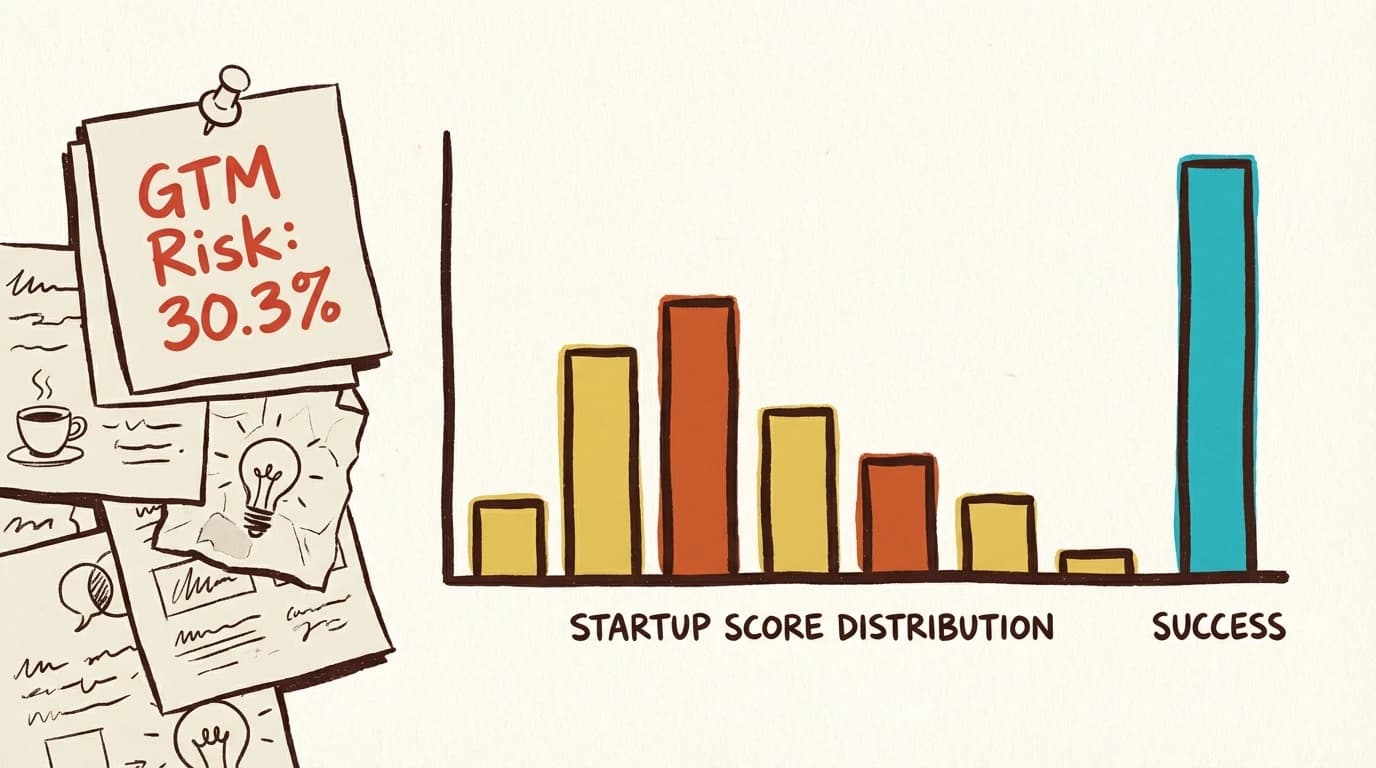
1,000+ entrepreneurs tested their startup ideas against 20+ live data sources. Average score: 55/100. Only 11% were launch-ready. The #1 killer isn't competition (7.3%). It's having no go-to-market plan (30.3%). Most ideas aren't bad. They just need 2-3 fixes before they're ready.
Everyone thinks their startup idea is the one.
We wanted to see if the data agreed.
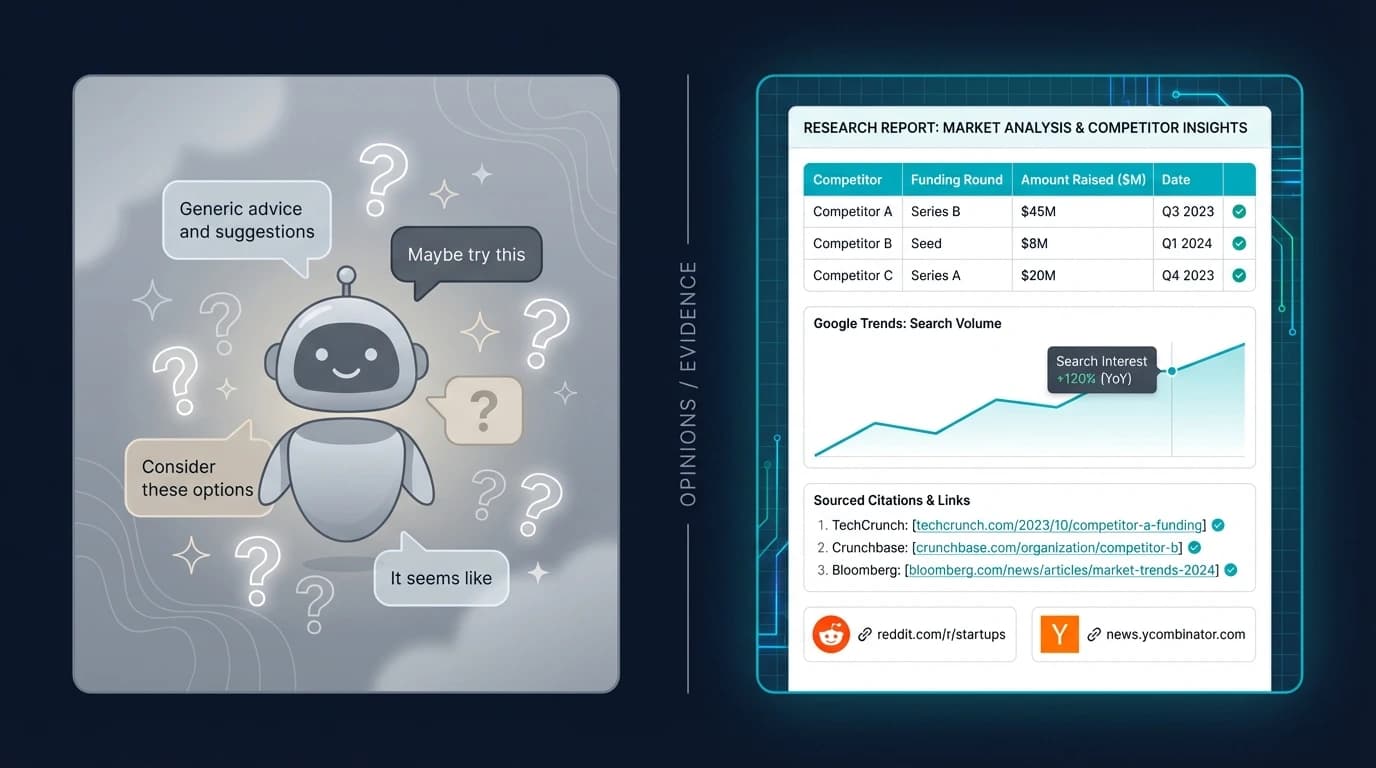
Over the past few months, 1,000+ entrepreneurs scanned their startup ideas through TestYourIdea, a startup idea validation tool that scores business ideas from 0 to 100 using 20+ live data sources including competitor databases, Reddit, Google Trends, and community forums. No ChatGPT opinions. Every number linked to its source.
Here's what we found.
How Did 1,000 Startup Ideas Score?
Every idea gets a viability score from 0 to 100. Here's how they distributed:
| Score Range | % of Ideas | What It Means |
|---|---|---|
| 90-100 | 0.1% | Near-perfect. Basically doesn't happen. |
| 80-89 | 0.5% | Exceptional. Strong on every dimension. |
| 70-79 | 10.3% | Launch-ready. Clear market, clear path. |
| 60-69 | 26.8% | Promising. Needs 1-2 fixes. |
| 50-59 | 26.6% | Mixed signals. Real problems to solve. |
| 40-49 | 32.3% | Most common. Needs significant work. |
| 30-39 | 2.7% | High risk. Major blockers. |
| Below 30 | 0.7% | Fundamental issues. |
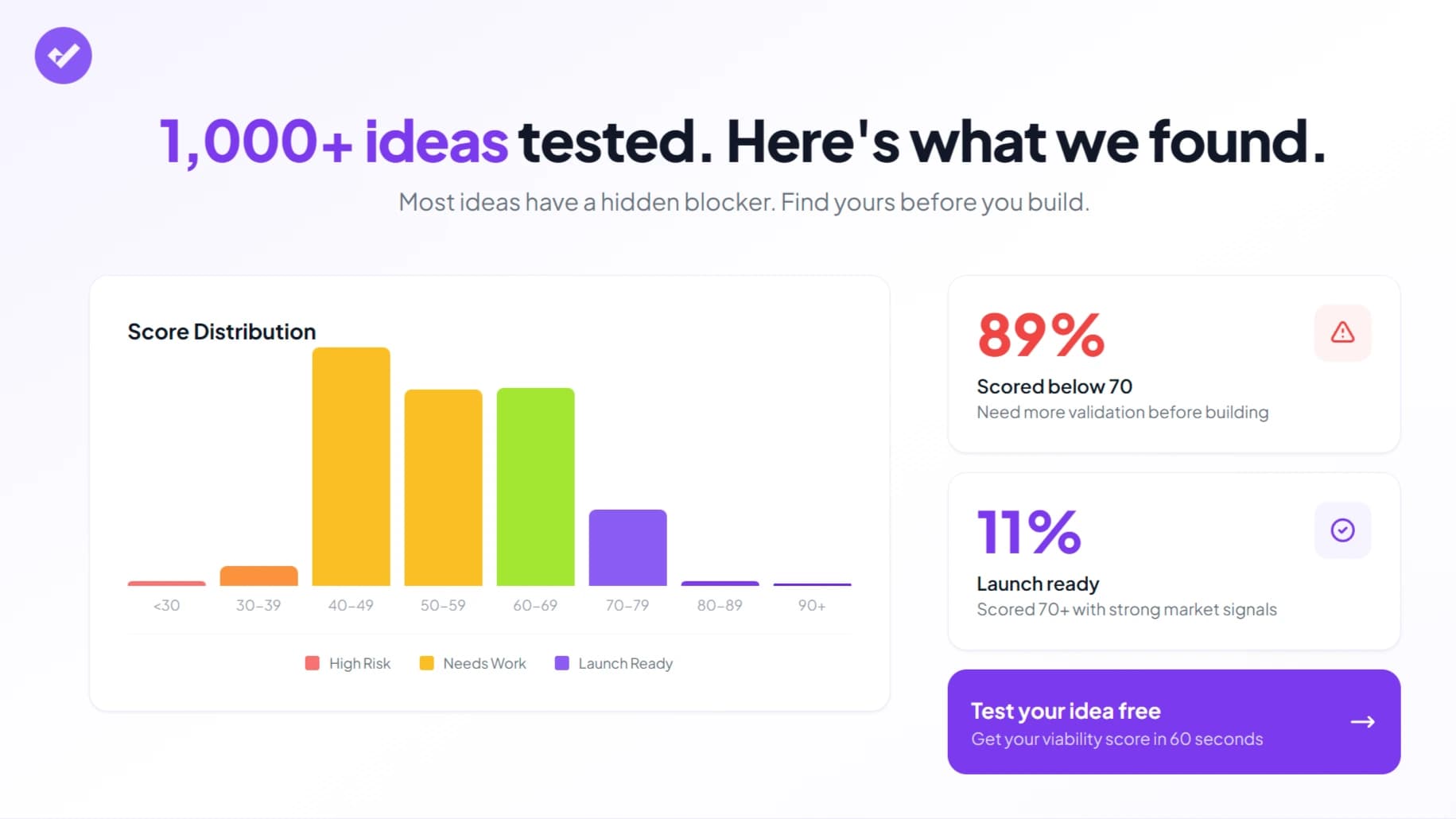
The average score: 55 out of 100.
The most common score: the 40s.
Only 11% scored above 70, which is what we consider "launch-ready."
Only 1 idea ever scored above 90. And it wasn't even a startup. More on that later.
Why Do Most Startup Ideas Land in the Middle?
This is the biggest takeaway. The distribution doesn't look like what you'd expect.
There's no pile of "0 out of 10, this is garbage" ideas at the bottom. And there's no cluster of genius at the top. Almost everything sits between 40 and 69. That's 86% of all ideas.
What does that mean? Most founders aren't delusional. They're onto something. But "onto something" doesn't mean ready to build.
The gap between a 48 and a 72 is usually 2-3 fixable problems: unclear positioning, ignoring existing competitors, or targeting a market that's too broad.
What Are the Top 5 Reasons Startup Ideas Score Low?
Across hundreds of ideas that scored below 60, the primary risk flag from each scan shows a clear pattern. Here's the actual ranking.
#1: No Go-To-Market Plan (30.3%)
The number one killer isn't a bad idea. It's a good idea with no distribution plan.
"I'll post it on Product Hunt and see what happens" is not a strategy. Neither is "I'll run some Facebook ads." The founders who scored lowest in this category couldn't answer one question: how does your first customer find you?
Building is cheap now. Getting attention isn't.
#2: Too Early, Too Vague (24.7%)
The idea is so undefined that there's nothing to validate. No competitors, but not because the founder found a gap. Because nobody has figured out the problem yet, including the founder.
This is the "I have an idea for an app" stage. No target user. No pricing model. No evidence anyone wants it. The scanner can't validate demand when demand hasn't been articulated.
#3: Regulatory Walls (14.8%)
Fintech. Healthtech. Real estate. Insurance. These categories attract ambitious builders who forget that code doesn't bypass compliance.
GDPR, HIPAA, KYC, financial licenses. These aren't edge cases. They're the first 6 months of your timeline and the first $50K of your budget. Many ideas in this bucket were technically sound but legally DOA.
Go-to-market risk is 4x more dangerous than competition. Founders fear the wrong thing.
#4: Capital Requirements Too High (9.5%)
Hardware projects. Logistics platforms. Anything requiring $500K before generating $1 in revenue.
In today's market, if you can't test your thesis with a $500 MVP, the execution risk is scored accordingly. Investors want traction before writing checks, and these ideas need checks before showing traction. It's a dead loop that kills momentum.
#5: Competitive Pressure (7.3%)
Here's the surprise: competition is only the 5th most common reason ideas fail.
Most founders worry about competitors first. The data says they should worry about distribution first. Go-to-market risk is 4x more dangerous than competitive pressure.
But when competition does kill an idea, it's brutal. The founder enters a red ocean with 50 VC-backed startups doing the same thing cheaper, faster, and with a 3-year head start.
The real insight: founders obsess over "is someone else doing this?" when the real question is "can I reach the people who need this?"
| Rank | Risk Factor | % of Low Scores |
|---|---|---|
| 1 | No Go-To-Market Plan | 30.3% |
| 2 | Too Early / Too Vague | 24.7% |
| 3 | Regulatory Walls | 14.8% |
| 4 | Capital Requirements Too High | 9.5% |
| 5 | Competitive Pressure | 7.3% |
What Did the Top 11% Get Right?
The 84 ideas that scored 70+ had a few things in common.
- ✓They could name their competitors. Not "there's nothing like this." They knew exactly who was in the space, what they charged, and where the gaps were.
- ✓They had demand proof. Someone, somewhere, was asking for this. A Reddit thread. A Google Trends spike. A Quora question with 50K views. Something.
- ✓They targeted a niche first. Not "all small businesses." Instead: "freelance designers in the UK who struggle with invoicing." Specific enough to build for, broad enough to grow from.
- ✓They had a pricing reference. They knew what the market was paying for similar solutions and positioned accordingly.
"No business plan survives first contact with customers."
The best-scoring founders didn't just have good ideas. They'd already done the homework. They talked to the market before asking an algorithm to grade them.
What Startup Idea Scored 99 Out of 100?
One idea hit 99 out of 100. The highest score any entrepreneur has ever received.
It was Fasah, Saudi Arabia's national import/export logistics platform. A government-backed system already processing billions in trade.
The scoring engine did its job: massive market size, zero competition (regulatory monopoly), government funding, proven demand. Every metric was at the ceiling.
But that's the point. The only idea that scored near-perfect wasn't a startup idea at all. It was an existing, government-funded infrastructure project.
Building something from scratch that scores even 75? That's genuinely impressive. If your idea scores 70+, you're in the top 11% of every idea ever tested on the platform.
What Should You Do With This Data?
If you're building something right now, the odds are roughly 9 in 10 that your idea needs work before it's ready for market.
That's not a death sentence. It's a diagnosis.
The founders who improve their score don't pivot to a completely different idea. They fix the 2-3 specific problems dragging them down. They narrow their audience. They research their competitors. They find proof that people want this.
The difference between a 48 and a 72 isn't a better idea. It's better homework.
Want to see where your idea stands?
- ✓60-second scan across 20+ live sources
- ✓Real competitors, real demand signals
- ✓Every score comes with sources, not opinions
No credit card required. 1,000+ entrepreneurs already tested.
Frequently Asked Questions
What percentage of startup ideas are actually viable?
Based on 1,000+ startup ideas tested by entrepreneurs on our platform, only 11% scored above 70 out of 100, which is the threshold we consider launch-ready. The average score was 55, and the most common score range was 40-49. Most ideas aren't terrible. They're just not ready yet.
What is the number one reason startup ideas fail?
The number one reason is lack of a go-to-market plan, accounting for 30.3% of low-scoring ideas. Founders build products without knowing how their first customer will find them. Competition, which founders fear most, is only the 5th most common risk at 7.3%.
How does TestYourIdea score startup ideas?
TestYourIdea scans 20+ live data sources including Reddit, Google Trends, Crunchbase, and community forums. Each idea gets a viability score from 0 to 100 based on real competitor data, demand signals, market size, and risk factors. Every finding links back to the original source.
What makes a startup idea score above 70?
Ideas that score 70+ share four traits: they name real competitors, they have demand proof from forums or search trends, they target a specific niche first, and they have a pricing reference from similar solutions. The gap between a 48 and a 72 is usually 2-3 fixable problems.
Is competition the biggest risk for startups?
No. Our data shows competition is only the 5th most common risk factor at 7.3%. Go-to-market risk (30.3%) is 4x more dangerous. Founders obsess over "is someone else doing this?" when the real question is "can I reach the people who need this?"
Can a low validation score be improved?
Yes. Most ideas score between 40 and 69, and the gap between a low score and a launch-ready score is usually 2-3 fixable problems: unclear positioning, ignoring competitors, or targeting too broad a market. The difference between a 48 and a 72 isn't a better idea. It's better homework.